


音频
Also available on
 Stitcher
The People’s Republic of China has been reforming its policing system at home, making changes to both to its hardware with digital surveillance technologies, but also with its governance software, focusing on grassroots capabilities, law enforcement training, media control, and censorship.
In many ways, police, in many contexts, represent the most recognizable face of state power. For China, consolidating police strength at the grassroots level is integral to its national security and maintenance of social stability. Viola Rothschild uncovers the links between internal and external security concerns. Although China is increasingly attempting to shape norms around global security, she cautions against the idea of China rolling out a master plan. “The model is not perfected at home, and it's certainly not perfected for export,” according to Rothschild.
这次采访是用英语进行的。
Eleanor M. Albert: Today our guest is Viola Rothschild. Viola is an assistant professor of comparative politics at College of the Holy Cross in Worcester, MA and a non-resident fellow in the Institute for Global Affairs’ Independent America program. Her research centers on state-society relations and grassroots governance in authoritarian regimes, with a regional focus on China. After completing her Ph.D., she served as a foreign policy analyst at the U.S. Department of State. She also previously worked at the Council on Foreign Relations and was a J. William Fulbright Scholar in China.
Viola, welcome to the show. I’m so glad to have you with us today.
Viola Rothschild: Thanks, Eleanor. Happy to be here.
Eleanor M. Albert: Before we turn to discussing some of your recent work, I always like to ask people how they came to study China. And then for the purposes of our discussion today, how did policing practices become something that you gravitated towards?
Viola Rothschild: I have been studying China for a long time. My mom is from Beijing. I went to China for the first time in 1995 when I was three to meet half my family for the first time, and I’ve been going back every few years since.
But my more academic journey started in college. I studied abroad in Beijing in the fall of 2012 and that was a super politically charged time. The 18th Party Congress was happening and shut down the entire city. Xi Jinping was coming to power. There were big protests happening outside the Japanese Embassy over the Diaoyu-Senkaku Islands.
And in my little world, the food street outside our campus where we would get lunch every day was being demolished and cleared. The people that were complaining, that were upset about their businesses and their livelihoods getting destroyed, were getting taken away by the authorities. I just got really interested in why some protests were allowed to happen and others weren’t; big picture how the Chinese state exercises control over its people.
My dissertation, and all of my doctoral research, tried to answer some of these questions on Chinese domestic politics, repression, grassroots governance and social management. I was looking at things like surveillance, dynamics between central and local governments, and community policing.
After I finished my doctorate, I shifted gears in a big way and went to work directly for the [U.S.] State Department, where for two years, I was an analyst focusing on China’s foreign relations, particularly their approach and their strategy for gaining economic, political, and diplomatic influence in the so-called Global South.
I left the State Department last spring and am back in academia now, where I’m trying to currently figure out how to marry these two very different strands of research. There’s clearly a lot there. There is definitely a connection between how China maintains stability at home and the product that it’s marketing abroad to leaders in many of these developing countries, and is proving very popular, whether it’s the hardware—the digital surveillance technologies—or this governance software—the law enforcement training, media control, and censorship model. So this is the domestic politics-foreign policy intersection where I’m finding myself now.
Eleanor M. Albert: It’s incredible. It becomes the security focus, but it's not necessarily purely motivated on the external side from a security perspective.
I want to pivot back a little bit though, because studying policing in an authoritarian context seems challenging for obvious reasons. Let's focus first on the domestic side. Can you walk me through how local policing works in China? Has it changed over time, especially given the hardware upgrades that have taken place?
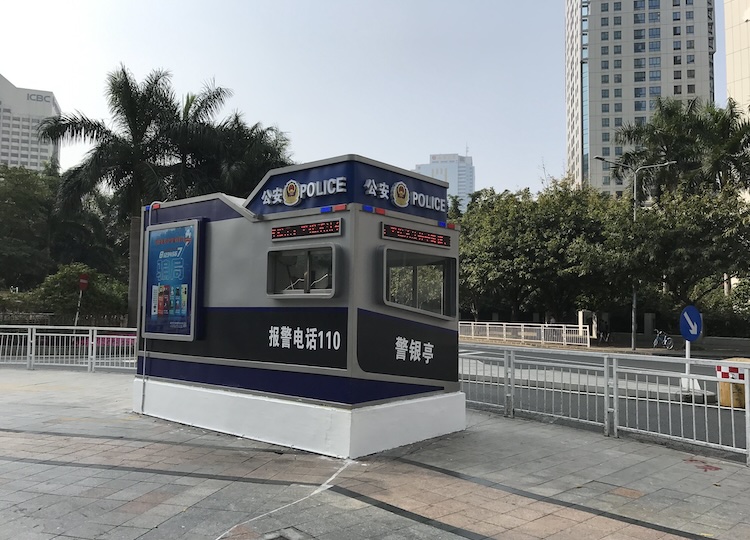
Viola Rothschild: Definitely. That's a great jumping-off point because when we think about China's massive and fearsome domestic security apparatus, interestingly enough, these days the police are usually not what first comes to mind. We think about the dystopian, disembodied digital surveillance systems. We think about the great firewall and the censorship apparatus. These are of course super important components, but it really overlooks this human, physical element of policing and law enforcement which has also been changing and evolving.
For a lot of people in China and elsewhere, it is the police that represent the most public, recognizable, common face of coercive state power. People see police officers every day and they don't just see them as repressive agents. Police, in theory, are also enforcing law, order, safety, some of the most important and basic public goods that states provide.
China's approach to local policing has been changing. I'll spare you some of the detail. But long story short, in the '80s and '90s, there was a big wave of police reform that popularized a community policing model that reallocated tens of thousands of county and city-level police officers down to neighborhood-level police stations. It's important to note that even though China makes headlines for its massive domestic security budget, it has one of the smaller per capita police forces in the world. Officers at the grassroots often face funding shortages; they're inadequately trained and this can lead to local police forces that often just can't do their jobs very well.
So if you factor this in with a mass reallocation and increase in everyday contact, the incidents of conflict between the police and the people went up. In the 2010s, there was this litany of high-profile police violence incidents that were recorded and posted online and really drew the public's attention to police accountability issues.
A couple examples: in 2016, Lei Yang, who was a 29-year-old well-educated Beijing man, died mysteriously in police custody. It was unclear why he was there in the first place and this became a huge deal. Thousands of regular people were posting online asking if they could be the next Lei Yang. There was a viral video of a police officer in Shanghai shoving down a woman that was carrying a baby over a parking ticket violation. A man was violently detained by police after he complained about the cost of hospital food.
What we've been seeing in recent years is the Ministry of Public Security, and beyond, engaging in this PR campaign that's become increasingly refined and media-savvy to humanize these frontline officers to project a reliable, relatable image of the police force to the people. There have been a series of popular hero cop TV shows. The social media following of municipal police bureaus is in the tens of millions often.
I was in China this past summer and was followed around a park by a little robot on wheels that was being controlled by a mobile police unit at the other side of the park, which was very disconcerting. But the robot was super cute with big, blink-y eyes and a little girl voice, so how scary can that be? Now, police are really portrayed by the state as either being these hero crime fighters or these friendly, benign service providers.
The last thing I'll say is that it's not just a shift in PR; it's substantive as well. The state is continuing to double-down on what official documents are calling a "downward shift in police work." In 2023, the Ministry of Public Security released a three-year action plan to significantly increase the deployment of officers into residential communities. The plan outlines three priorities for police work and number one is strengthening grassroots
capabilities by continuing to increase the allocation of resources to the grassroots and really consolidating strength at the grassroots as a foundation for national security and social stability.
What we're seeing is a focus on developing a proactive and preventative policing system where you have a lot of trained officers that are very, very deeply embedded in a community, and are able to detect and neutralize potential issues before they get out of hand.
Eleanor M. Albert: I want to follow up with two questions. One is can you tell us a more about who oversees policing in China? In terms of the institutional bureaucracy and the actors. And then as a second part, you were talking about developing this more proactive policing approach, grassroots capabilities. What does this look like in practice? You mentioned being followed around by a robot. Is that part of this community policing? What is the police in China at this grassroots level intended to do? What are the types of threats that need to be neutralized?
Viola Rothschild: There are a lot of moving pieces. At the central level, most police work falls under the purview of the Ministry of Public Security. Community police stations, pai chu suo, are the most basic units of China's police system at the grassroots, but these officers are working in tandem with community political institutions, which is really important. Frontline police officers will often either serve on or adjacent to township or residential committees, which are the lowest level of community governance in rural and urban areas respectively.
This gives police a lot of insight into percolating grievances in a community: who is socially or politically influential, any ongoing disputes or issues that need to be nipped in the bud. So on top of these regular officers, communities will also sometimes host unofficial neighborhood watch-esque enforcement associations, like the security protection committees, or voluntary police or auxiliary police that are usually contracted by local police stations are part of this grassroots security apparatus, and are stationed in neighborhoods keeping an eye on whose coming and going, like any suspicious foreigners that might be roaming around their parks, if anything sketchy is going on. Sometimes these are nosy retirees from the communities themselves. These are the grannies with the armbands that you see sitting on the streets outside of neighborhoods. Sometimes they're younger, more professionalized people hired from outside the
community.
Increasingly, these neighborhoods are also being overlaid by a grid management system which further breaks down the administration and control of residential areas with a couple hundred households in each grid unit. These are staffed with professional community grid workers that are responsible for what's going on in their block. There's some overlap and redundancy within these different groups. So you have this patchwork of different actors and institutions whose job it is to assist in self-governance and solve issues in their micro-jurisdictions before they escalate. But, of course, they're also playing a huge human surveillance and political compliance role within these neighborhoods as well.
Eleanor M. Albert: Really fascinating. Connected to that, I'm very curious about the role of the internet. You led with providing some context of incidents of conflict between police and Chinese citizens. A lot of this information spreading via posts. But, you also talked about having a large budget dedicated to trying to improve the PR and reputation of the police in the eyes of the community.
I would presume that the internet can cut both ways in this instance. At this moment in time, where do things stand? Has the internet been a problematic source for the government in trying to manage the way in which it polices? I can also see it being a large source of data that can then be mined and then applied at the grassroots level through some sort of surveillance. How do we reconcile the role that the internet plays in navigating the way in which policing is perceived?
Viola Rothschild: That's a great question and taps directly into one of the main findings from a recent working paper that I have with Professor Hongshen Zhu, who is an assistant professor at Lingnan University in Hong Kong. We find that when it comes to public opinion and perceptions of police, perceptions are shaped by people's real-life experiences. So, depending on a citizen's proximity to the police, they get a more unvarnished, real-life picture of what policing can look like, which still can be pretty rough around the edges. Despite these different campaigns to try to professionalize and better train officers, there's still a lot of incompetence and malign behavior among these grassroots police forces.
But then, citizens that aren't as proximate to the actual police, I think, are able to better maintain these images that are propagated by the media. They're able to keep this untainted image of, again, the hero cops, the service provider. So it really has to do with a person's lived experiences and what they're perceiving on the ground, versus what is being put out there by the state.
The second part of your question about how the state is using the internet, of course, this is part and parcel of the digital surveillance apparatus. We have been seeing that be packaged as part of the tool of social control that has been used in a very widespread way, and has certainly had massive implications for behavior, and social and political compliance.
Eleanor M. Albert: This helps us transition to talking about how the reform of China's own policing model at home comes in tandem with China's taking on a more active role in global governance and security cooperation. Do we see China's domestic vision of policing and public safety shaping the ways in which it engages in security cooperation abroad? Is there a link between the domestic and the international when China thinks about safety, or are these two separate pillars?
Viola Rothschild: I would say absolutely related. Very early in the Xi years, he introduced the idea of a comprehensive national security concept which really laid out this unifying theory that combines both internal and external security concerns. Whether it's resource security, or tech security, cultural security,
territorial security...
Eleanor M. Albert: Ideological security.
Viola Rothschild: Yes. Many of these areas have both domestic and foreign policy dimensions that Xi has identified as being critical to maintaining internal regime and party stability, which is the top priority always. This conceptual linkage of internal and external security has had concrete impacts on what China's doing in the global security space.
For one, of course, through things like the Global Security Initiative that was introduced in 2022, we've seen China package and promote its domestically focused vision of security to the rest of the world. As it turns out, China's expertise in maintaining domestic security and regime stability is a very attractive product, especially to governments in the developing world.
In September of last year, the Lianyungang Forum on global public security cooperation attracted over 2,000 people from 120 countries and international organizations. One of the key themes of the forum was law and order maintenance, and the forum showcased this very impressive array of both, again, these Chinese hardware—drone, surveillance equipment, facial recognition programs—but also software: police trainings with political security components, public security capacity building seminars, international police education cooperation, that sort of thing. You really do see this clear through line between what China is doing domestically and what they're pushing in their foreign relations as well.
Eleanor M. Albert: Now, the big perennial question here when we talk about anything as it relates to China's overseas engagement is, is it exporting a policing model with Chinese characteristics? So first off, is there a model like this that is exporting from a principled perspective? And then how can we tell? Is this widespread? Police trainings—this is probably a core component of this. What do they entail? Talk me through about the idea of a Chinese model of policing that gets exported around the world as a product to the broader so-called Global South.
Viola Rothschild: I'll tackle the second part of that question about what this looks like in practice first, and then we can move on to the exportation of a model, if that is indeed happening.
In terms of logistics, Sheena Greitens and Isaac Kardon are the experts on this. They published a great new study on China's global police training footprint at the end of last year where they compile a really impressive data set of around 900 law enforcement trainings provided to at least 138 countries over the last five years. Suffice to say, it is definitely widespread. Most of these trainings are taking place either on China's periphery in Southeast Asia and Central Asia, and then also in Africa where China has had strong relationships with many of the countries there for decades. And as Greitens and Kardon's data show, most of these trainings are being conducted on a bilateral basis, but some are also being done through multilateral organizations, like the Shanghai Cooperation Organization.
On the Chinese side, there are a variety of domestic institutions that are involved at the central and local levels. Of course, the Ministry of Public Security. But under that, provincial and municipal public security bureaus and provincial level policing colleges around the country are involved in and actually carrying out the trainings.
In terms of what the trainings actually look like, the most common kind of police trainings takes on the form of a host institution in China, say the Zhejiang Police College, inviting a delegation of officers from a country to attend courses at their institution for a few weeks. These courses consist both of the more generic classes on China's law enforcement system, and then more specific content on whatever has been identified as the topic for the course, whether it's counterterrorism or law enforcement regime security, keeping public order,
drug trafficking…
In addition to the in-classroom training, there's also a soft power element. Foreign officers will learn a little bit of Chinese, they'll visit cultural sites, they'll go out to Chinese restaurants, they'll take Tai Chi classes. Though, I should also mention that there are a few instances of more intense law enforcement cooperation where Chinese advisory groups are dispatched to a country to spend time there training local forces and we've seen this in a few Pacific Island (PIC) and African countries.
The last thing I'll say on this is that there are mixed reviews on the efficacy of these trainings. When I was at the State Department, I had the chance to visit several African countries and talk to experts and officials on the ground. The consensus was that the quality and usefulness of these trainings is mixed, but overall improving. Similar to many other aspects of their relationship with China, whether it's economic, or educational, or military, that even if some of these countries might prefer to engage in law enforcement trainings with the U.S. or other countries, China is the one that's offering, China is paying for it. Even if the participating country isn't getting a ton out of it, there are fringe political and diplomatic benefits.
And like I said, there's a consensus that the trainings are getting better. So even if the officers aren't coming home from their all-expenses paid trips to China ready to rock with the most cutting-edge policing methods and technologies, they're still coming back with something, whether it's connections, or ideas, or experiences. This is how big picture, I think, that we're seeing increasing Chinese influence in global standards, and in security and police work.
Eleanor M. Albert: To pivot us back: is this a model? There's a real question about whether we should view an offering of training and how to use certain types of hardware or how to use certain types of policing tactics. Should we see that as a model? Is there something there in terms of their being a model? Does China want to be perceived as providing a model for policing?
Viola Rothschild: I think there are two things. There is China exporting a model question and then there's a how exportable is this model, how transferable is this model.
In terms of the latter question, at least, the short answer is we don't know yet. China is obviously very unique in many ways. The size, bureaucratic capacity, how central-local relationships and implementation work, and the extent to which these teachings and technologies are transferable to what are obviously very, very different contexts is something that we just don't have the data on yet.
One case that I flagged that got a lot of attention at the end of last year was the Solomon Islands. There, for what I think is the first time, we saw China not only supply the technologies, and the police cars, and the uniforms, and carry out trainings both in China and on the islands, but what's new is that they are explicitly trying to teach the Fengqiao model of social management, which is a Mao-era innovation now upgraded with digital tools that combines many of the factors I was talking about earlier in the domestic Chinese context. This more integrated and holistic approach to community management and policing where everybody has a role in maintaining neighborhood harmony. Subtext: everyone can be an informant; everyone is watching everybody else all the time. This has raised a lot of red flags. The case has been framed as a microcosm for the struggle between Chinese versus Australian influence in the Pacific and further evidence that China is exporting this techno-authoritarian model.
According to Chinese state media, which published a pushback to this narrative, they say there's no-one-size-fits-all model. They're just trying to support stability and development in the PICs, and this concern is a reflection of the West's mounting geopolitical anxiety.
To get more towards the is China exporting a model question, it's complicated. Yes, China, I think, is increasingly trying to shape norms around global security and has found many interested and willing partners. And no doubt that is concerning. But I'd also caution against the wholesale leaning into the China has it all figured out and they're rolling out their master plan.
As I said earlier, the reviews from countries that are actually working with them on this stuff are mixed and their approach is landing differently in different places. From what we know about domestic policing, we're finding that in the domestic community policing context, there are still a lot of issues in terms of people actually trusting the police and these community governance structures that they're embedded in, and that there are potentially negative externalities for grassroots governance and social management broadly.
The model is not perfected at home and it's certainly not perfected for export. But this is something that I'm really interested in exploring in future research, though it's tough from a data gathering perspective. What does this mean for people in these countries that are adopting Chinese policing hardware and governance software? What are the implications for global rules and norms around security and policing? As China continues to exert more influence in the global security space, these questions will only become more important.
The views and opinions expressed are those of the speakers and do not necessarily reflect the position of Georgetown University.
Outro
The U.S.-China Nexus is created, produced, and edited by me, Eleanor M. Albert. Our music is from Universal Production Music. Special thanks to Shimeng Tong, Tuoya Wulan, and Amy Vander Vliet. For more initiative programming, videos, and links to events, visit our website at uschinadialogue.georgetown.edu. And don’t forget to subscribe to our podcast on Apple podcasts, Spotify, or your preferred podcast platform.