


Listen to Audio
Also available on
 Stitcher
China’s foreign development assistance is global in nature.
According to podcast guest Alicia R. Chen, “the footprint is enormous,” totaling around $70 billion per year in overseas development finance over the past two decades, depending on how one defines “aid.” Chen discusses the scope and scale of this Chinese funding, including the different types of Chinese institutional actors involved. Not all development assistance is geopolitically strategically deployed, but when it is, China is often mindful to target the leaders of regional organizations. This move, in some ways, bolsters China’s efforts to “identify itself as the leader of developing countries,” organized around these regional organizations.
Eleanor M. Albert: Today, our guest is Alicia R. Chen, a Ph.D. candidate in political science at Stanford University. She studies the political economy of China’s international aid and finance. Prior to doctoral studies, Chen was a research specialist with the Empirical Studies of Conflict (ESOC) project at Princeton University. Alicia, welcome to the show. It's a real treat to have you.
Alicia R. Chen: Thank you so much for having me on.
Eleanor M. Albert: To kick us off, I'm always curious about how we as researchers come to our topics. So I was wondering if you could walk us through how you came to study China's international aid and finance.
Alicia R. Chen: I actually came into the Ph.D. much more focused on security studies than on international political economy. Obviously one of the defining geopolitical shifts of our time is the rise of China and the changing relationship between the U.S. and China. I think once you start thinking seriously about the consequences of China's rise, it naturally pushed me towards studying China's outward economic policies, in part because it's one of the main ways that its power is experienced and projected around the world.
What drew me in specifically is that China's rise is, in large ways, driven by its economic rise and its economic reach around the world—it's really visible. It's one of the clearest manifestations of its rise. And because of that, it's generated a lot of concern. There's a lot of policy interest in it. But at the same time—at least when I started the Ph.D.—it felt also like it was very opaque and poorly understood.
Early on, I felt like there were lots of intuitions I had about what China was doing that was either missing from the policy conversations and some of the academic discussions that I felt was a little bit more complicated perhaps than the conversations that people were having. What drew me to aid and development finance in particular is that, in some ways, it turned out to be a very useful window into studying this topic because there's been a tremendous amount of work being done over the past two decades trying to build systematic data on it.
In part because things like the BRI attract a ton of attention and it's very visible, but the data work I think has really made it possible to study these questions in a rigorous way. So, I think naturally it drew me to this topic.
Eleanor M. Albert: That's fascinating and so true. I think ironically, my own research interests did the opposite. I came in very much thinking I would be focused on the economic side and I actually turned back more towards the security side. I've always been interested in the nexus because, I think with China, it's really hard to say that one is one and not the other. There's this incredible kind of enmeshedness.
You authored an article recently about aid with "Chinese characteristics." There's been, as you mentioned, so much attention to the expansion of China's global footprint, particularly since the 2008 financial crisis. And of course with Belt and Road [Initiative, BRI]. But could you contextualize just how vast Chinese aid and development finance is in the world, how many countries receive this assistance? How does it stack up against what other countries are providing?
Alicia R. Chen: The answer to this question, it can be quite controversial because it ultimately depends on how we want to define aid. If we consider all forms of money that flow from one government to another—that's why a lot of scholars use “development finance” because it's more than just aid—then China's a really big player. In the last two decades, since 2000 to about 2020, it's extended about roughly $70 billion per year in overseas development finance.
That's much more than what the U.S. has over the same period. These are the kind of figures you typically see in headline reports about China's aid program, China's development finance program, which creates this concern about China's rise. It's global in nature. The footprint is enormous. I think almost every country—maybe there's like 15, 20 that haven't received some form of financing from China.
It's really a big program, but things look really differently if we are precise about what we mean by aid. Aid in the traditional sense, often we think of concessional grant-based funding. Think of the aid coming out of, say USAID [U.S. Agency for International Development] from the U.S. That's typically what we think of when we think of aid. In terms of that, China really doesn't give a lot of aid.
Only about 10% of its overall portfolio fits into that more traditional definition of aid. The closest analog to something like USAID has a much smaller budget annually. The government agencies that participate in this true aid program has an annual budget of about $3 billion in the last couple of years. That's a fraction of USAID's budget, [which] is about $40 billion in 2023, for example.
But I think what makes China distinct is that it's not just a massive donor in a traditional Western sense. It combines a lot of different things together. There's very limited grant-based aid, but it has large volumes of other forms of financing that are from state-linked entities.
In that broad definition, a lot of countries receive it and we can see that. How big China's aid and development finance program is relative to other donors really depends on how we want to slice it because ultimately it's a question of what kinds of comparisons are we comfortable making and whether we are willing to make comparisons across actors that don't really map on neatly onto one another when we think of the classic aid in the Western context.
Eleanor M. Albert: Right. The traditional ODA, official development assistance or aid, doesn't exist within China. I wanted to ask a follow-up question in terms of the fact that China created an actual aid agency, right? It's the China International Development Cooperation Agency. It was in 2018, I believe. Since then, you gave a picture of the numbers of what we would consider more traditional aid.
Since that institution has been created, has there been more aid or is it just a differentiation of the types of assistance? Does CIDCA do particular types of aid that have then been siphoned away from other things that MOFCOM used to be doing?
Alicia R. Chen: I don't get the sense that that's the case. I get the sense that there were some bureaucratic infighting between the different ministries in China. And CIDCA was this agency that they created to try to consolidate these different groups of people that were sitting in different ministries. I get the sense that it mostly took a bunch of people from different offices and put them in the same office. A lot of the same procedures still follow and they're still using them. The critical thing is that it's just a really tiny share of the rest of what China's other agencies are doing.
Eleanor M. Albert: Throw the [COVID-19] pandemic in and then who knows what numbers look like these days. Me bringing up this agency makes me want to have you unpack a little bit more about how Beijing distributes its aid.
What are the vehicles through which it does this assistance and development finance? Who are the institutional actors? Have they changed over time?
Alicia R. Chen: Again, I think the actors that we consider as part of this program depends on the definition that we use. In part, this is important because different data sets capture different parts of China's development finance program depending on how they themselves define it. So some are going to focus in the broadest sense of capturing any money that's coming from state-affiliated entities, where some only focus on the more narrow definition of aid or aid only coming from certain actors.
The empirical choice as researchers is quite important in that sense. But if we take a broad view of what people typically think of when they look out in the world and see pictures of Chinese aid and finance, broadly, I would say that there's three categories of actors. First there's government agencies. That's going to be things like this new CIDCA agency that was created that is the analog of USAID.
Then obviously, the classic government industries that used to be part of this, that used to be the leaders, which is the Ministry of Foreign Affairs, the Ministry of Commerce, and the Ministry of Finance who set the budget. So if we're going to consider aid in the traditional sense, these are the only players because, at least in China, that's the players that are authorized to distribute aid in their definition.
Second, there's policy banks. In particular, there's the China Development Bank and the Export Import Bank of China. These are two of China's three policy banks that participate in overseas financing. These are the core of China's development finance portfolio. They make up the core because they make up the bulk in terms of dollar amount of China's portfolio.
Then third, I would say there's state-owned, more commercial entities, and in particular state-owned commercial banks. But increasingly there's been SOEs that have become, in and of themselves, trying to finance some activities and because they're state-owned, they get merged in…
These entities, I think, are a little confusing. These are state-owned, but I would say most research finds that they operate in ways that look much more commercially driven than certainly policy banks and definitely ministries. They're state-owned, but at least in China's system, they have a very profit-driven mandate.
Eleanor M. Albert: China, in many ways, has completely adopted the market forces in terms of how they make their decision-making.
Alicia R. Chen: Yeah. In my view, there's these three classes of actors, mostly because the policy banks are interesting because they have both a political and economic mandate. The commercial banks, even though they're state-owned, have a more commercial mandate. Then obviously the ministries, to the extent that you can call it only political, they very much do follow political directives.
Actually the part that's confusing and that creates a lot of concern is that, even despite the fact that maybe on paper, commercial banks have a commercial mandate, I think there's always a fear that none of these actors can be really understood as independent from the state because of the way that the Chinese system works. That's where the concern comes from, that maybe this is all aid, that all of these actors are going to pursue some kind of geopolitical motivation when they're making allocation decisions.
Now, personally, I think some of my research shows that perhaps, some of these concerns may be a little overblown. At least most of the aid that's coming from the banking side tends to not be as consistently geopolitically motivated. I find that government agency aid is really where the strongest geopolitically motivated allocation shows up more consistently. Whereas the banking side, especially the commercial side, but also policy bank lending can reflect different motivations that aren't geopolitical in nature.
Eleanor M. Albert: I saw you had some other research that disaggregated the top-down way in which aid is conducted. I think the Chinese system is complicated because it is so institutionally dense. We were just talking about aid and we are already talking about three buckets of actors, and then within those buckets, you have multiple ministries that have power struggles over who really controls aid allocations, et cetera.
Now that's still just talking at the top level. Aid can also be allocated from sub-national levels. How much is driven by the central interests through power players in Beijing and throughout the other commercial banks versus the provincial level? China has this long history of having sister provinces, sister cities that I can imagine create certain types of relationships that might lend themselves well to aid distribution or development distribution. So how do we understand this sub-level? How does it fit into the broader China development finance equation?
Alicia R. Chen: At the central level, if we think about how most governments conduct aid operations, oftentimes they're geopolitically motivated. To the extent that we can really identify whether or not this money is representative of central motives, empirically what we can say is that, at least consistently, we see that aid from the government ministries are following what we would think China's geopolitical motivations are, whereas we don't find that for aid coming out of non-government ministries.
So then the natural question is, “Well, if it's not about geopolitics, then what is it really about?” That is, as you mentioned, what I'm trying to tease out in some of my other research. My own view is that a lot of it is better understood precisely from this domestic political economy lens. And in part, I think there's an institutional foundation for that.
The way that China runs its economy, the way that its economy is governed, is very much delegated to a lot of these sub-national actors. So in some ways you can understand it in a similar way where each province and each jurisdiction within the province operates things within that jurisdiction. The tricky thing is that a lot of these policy banks and China's commercial banks also have branches in these different jurisdictions. And those, even though they are state-owned, maybe headquarters are in Beijing, may be subject to a lot more influence from local actors than we might expect in a system like China's.
What I study is how do these local interests affect the allocation of Chinese aid, even though it's money that is going overseas. In my own view, I think a lot of what's happening with this pot of money can be understood by looking at how it serves China's domestic objectives, whether that means supporting certain firms, supporting industrial capacity, advancing broader economic priorities at home of the provinces, that are central to party survival in China.
I think the entire system is very much shaped by a very strong domestic institutional arrangement that a lot of people that study China know about, but I don't think that has really made its way as much to some of the conversations about China's overseas activities. Once you adopt that view, I think some of the major trends also start to make sense.
Traditional aid coming from China started under Mao, but the broader development finance program really expanded dramatically after, first in 2000 and then in 2008. That coincides with a period where the party really tried to inject a lot of stimulus into the local economy and try to push this going-out strategy as domestic markets are shrinking. You can view this expansion in China's overseas development finance program to not just be about external influence, but also in ways addressing some of the problems economically that they're facing at home.
Eleanor M. Albert: That's great. That helps us pivot to talking about China actually having a strategy with its aid allocation. Obviously not all of it is deployed strategically for geopolitical purposes, but for the instances in which it is, what is, in fact, its strategy? Who does it target externally, and why does it do this?
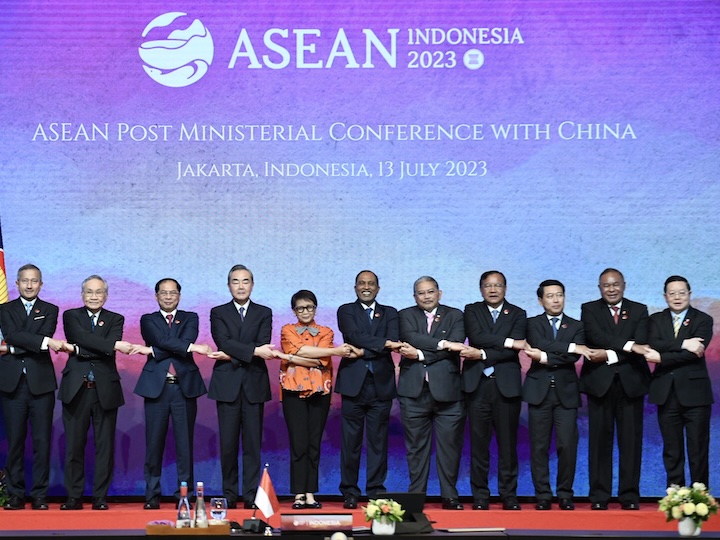
Alicia R. Chen: So in my own research, I looked at whether or not China was using aid to try to gain some political influence over regional international organizations like ASEAN in Southeast Asia or the African Union in Africa.
What I find is that when countries chaired one of these institutions, the chair country received a lot more financing from Chinese government agencies that year compared to when they weren't chair of that organization, which I interpreted as suggesting that at least China was trying to exert some influence over the chair to get them to exercise some of their agenda setting power in those institutions.
That suggests to me that this form of aid from government agencies is being deployed strategically to engage countries that occupy especially important diplomatic or geopolitical positions. So there's definitely a strategy there.
Some other research, both before this paper came out and since, have also pretty consistently showed that this kind of traditional aid is motivated by the same kinds of geopolitical factors that traditional donors
have also been found to follow when allocating aid.
Whereas, oftentimes, when it comes to state-owned commercial banks or policy banks, you really don't see the systematic pattern. In my research, when I look at the chair of ASEAN or the African Union, I don't find that they're receiving more money from the banking side of things. That matters a lot because it suggests that not all of China's overseas finance is doing the same thing, but I think it also matters because the banking side is really where the majority of the money is coming from.
It forces us to think about, when we want to engage with China on this front, what are some of the areas where cooperation can still exist, and where are some of the areas that for a country like the U.S. that really wants to fight its geopolitical influence, where are the right places to look for that influence and to fight back?
Eleanor M. Albert: I think that's really interesting. And I'm curious why a regional organization matters so much.
A lot of my research is about China within global governance institutions. It was initially inspired by this sizable number of institutions that China is a part of whether that's the Shanghai Cooperation Organization, whether that's ASEAN [Association of Southeast Asian Nations], ASEAN plus 3, FOCAC [Forum on China-Africa Cooperation], CELAC [Community of Latin American and Caribbean States]…
What is it about regional organizations that provides greater leverage for China as opposed to a place like the United Nations where there are a lot more other power players involved? What is it about the regional organizations, and what does China want to get out of those relationships?
Alicia R. Chen: You're totally right. I think a lot of people who follow how China conducts its diplomacy notices this regional orientation to its foreign policy. In many ways this is consistent with that. There's a couple of reasons that I think regional organizations are important for China.
Ultimately, China has a preference I think for engaging in this regional manner in some ways because I think it's easier for them. That's not really necessarily something I can say empirically in terms of the research that I'm doing, but if we think about the UN where there's a lot more institutional legacies that represent other, non-Chinese interests, Western interests, in terms of both the institutional design of these organizations and also the influence that the U.S. and Europe sometimes have over these institutions, it makes sense for China to want to create either parallel or other venues for them to push things through.
I also think regional organizations in particular help China deflect criticism in a way that tends to be really valued for China. And in particular, I think China tends to be sensitive to criticism globally. There is something to be said about it identifying itself as the leader of developing countries who are oftentimes organized around these regional organizations.
I think the support that these regional actors provide China fits within the picture that they want to present themselves as. It also gives them a lot of legitimacy to project the image that they are a leader that represents developing countries. It also helps when they don't criticize China on certain things. For example, in the South China Sea being a key example where depending on who is chairing ASEAN, the degree of criticism towards China and the South China Sea really varies.
I think China likes when there's no outward mentions of what maybe not very appropriate things that it's doing. And so I think, even if it is just rhetorical support, it seems to value that and we can debate about why that is, but China certainly seems to value that. A lot of what China cares about is economic. These regional organizations often play an important role in shaping regional development priorities. And if we think about, even its development finance program, the BRI, et cetera, these projects sometimes cross national boundaries, which require some kind of institution to help coordinate that. A lot of this decision-making happens through these regional organizations.
So, to the extent that regional organizations can shape the development trajectories, which influences what China can really do and get from these places, that also is another reason why regional organizations might be valuable to China in ways that global institutions like the UN might not be able to offer.
Eleanor M. Albert: The other fundamental thing is that when you have a regional summit, everyone is there, so it provides a physical ability to coordinate... Not that China is hands off in rolling out the red carpet diplomatically when it wants to. But that being said, that doesn't mean that it wants to be expelling all that energy all the time when it can very much make use of a regional summit platform.
And I think, if nothing else, narrative framing is something that China values a lot. Most countries value it too, but when you have an ability to try and shape it, I think it becomes even more important to you—especially when there's been narrative written about you that you might disagree with. And so it provides a venue to do that.
In terms of the criticism, I think, China interestingly is okay with criticism from the West and other major powers. But when it's coming from regional actors that are part of what it might label the so-called Global South, criticism from the developing world, I think it is more sensitive to their positions and wanting to make sure that they present themselves as aligned with them, even if they might not always overlap.
That is a good concluding point, but I'm curious about how the shifts in both China's narratives around the Global Development Initiative might impact some of this aid. I'm also curious in thinking about China's own economic trajectory domestically is not going so well.
How we might see, or if there already have been, shifts in the types of allocations that it's making, whether commercial banks and the development banks have shifted their strategies, the budget because of the slowing growth, which for China seems like perhaps contraction-based on what it's experienced. But with the economic indicators where they are, should we expect shifts? Where might they be?
Alicia R. Chen: China definitely seems to be more cautious in extending overseas finance for a couple of reasons. One, there's this learning process where I think they're starting to realize that maybe some of these debts aren't going to be repaid. But some of the major defaults have been a surprise and they may not have gone in fully recognizing some of the real risks associated with lending to developing countries. So, in part, it's a learning process from that.
Then you really see debt starting to slow down, and I don't think that's unique to China. I think a lot of great powers have experienced this arc and coming to terms with that and then figuring out where to go from there. And you already started to see slowing down after 2016, after some defaults.
I also think that there was a reputational dimension to it where it attracted a lot more negative attention than it perhaps was expecting. So, I think, in part, it also stopped wanting to be as generous in giving that money, realizing that maybe they weren't even going to get rhetorical or public goodwill from some of these activities.
There was a time when BRI as a term in China became really controversial to say, whereas that's really different if you look at in 2013 when this all started where everyone really wanted to label everything BRI if they could. There's that more political component.
And then obviously economically, there clearly seems to be a contraction in the budget allocated for overseas finance. A lot of the major actors that we're discussing here have really ramped down in their financing abroad.
And whether that's because they are learning of the risk and therefore no longer willing to make some of these investments, that's one explanation. The other one is that maybe centrally there was some directive to be more cautious and to not have as much of the budget allocated to that.
I do think that it reflects where China is domestically. It's going to reflect in some ways how it chooses to transform its economy in the next stage. And I'm not exactly sure exactly how that's going to go. There's some other researchers that have theorized about whether or not China's going to follow the West in the way that it's shifted from a debt-based program to a more aid-based one and really decrease the total amount of value that it gives, or whether it's going to figure out some way to maneuver in this space and find its own way of doing things, I think remains to be seen.
But certainly in this moment, there's a contraction in the amount of financing that is going abroad. Even if you talk to development practitioners in the Global South, they'll say that money that usually was very easily negotiated is much harder to negotiate now than it was even five, seven years ago. They're also experiencing the skepticism coming from China's side of wanting to give this money out.
The views and opinions expressed are those of the speakers and do not necessarily reflect the position of Georgetown University.
Outro
The U.S.-China Nexus is created, produced, and edited by me, Eleanor M. Albert. Our music is from Universal Production Music. Special thanks to Shimeng Tong, Tuoya Wulan, and Amy Vander Vliet. For more initiative programming, videos, and links to events, visit our website at uschinadialogue.georgetown.edu. And don’t forget to subscribe to our podcast on Apple podcasts, Spotify, or your preferred podcast platform.