


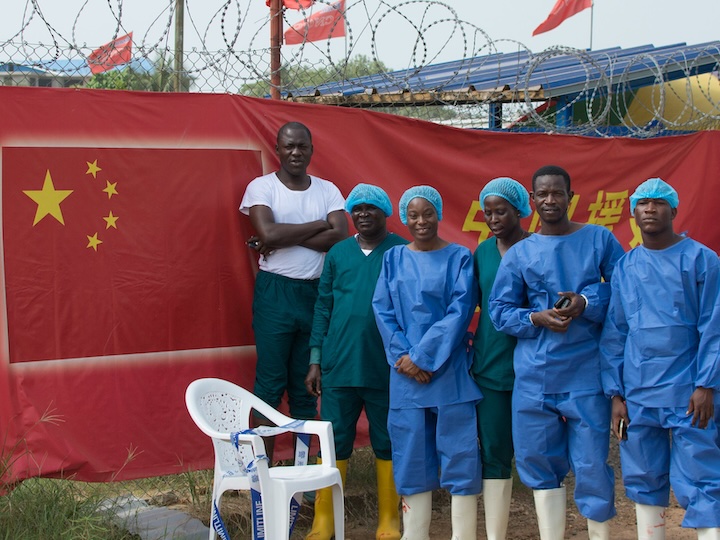
Reflecting on China’s Global Health Engagement in Africa
Podcast Series:
Listen to Audio
Also available on
 Stitcher
China has been engaging in global health aid on the African continent for 60 years.
The roots of this engagement started as a vehicle for solidarity against Western imperialism under Mao Zedong. In this podcast, Jennifer Bouey discusses her latest research exploring the history and scope of China’s global health engagement. According to her, this aid is both diverse and cumulative, spanning medical training and health infrastructure. While the grand strategy of this aid remains set by the Chinese Communist Party’s Central Committee and has long emphasizes economic returns, under Xi Jinping, there has been a shift to not just provide material aid, but focus on health as a global public good.
Eleanor M. Albert: Today our guest is Jennifer Bouey. Jennifer is the Tang Chair for China Policy Studies at the RAND Corporation and associate professor and chair for the Department of Global Health at Georgetown University. Her research focuses on health, technology, and social issues.
Jennifer, welcome back to the show. It's always a pleasure to have you.
Jennifer Bouey: Great to meet you, Eleanor, always be a great pleasure to be on your show.
Eleanor M. Albert: We're having you on today because you have some new research recently released that's about China's global health activities in Africa, looking back historically and also focusing on some case studies. Can you give us a quick summary? How has China's engagement in global health work in Africa evolved over time? How long has it been doing this kind of work?
Jennifer Bouey: This is a great question. And that was the focus of this report. We won't have lots of time to go through the details, but this RAND report onChina's global health activities in Africa includes both the historical perspectives, as well as two case studies I did in Africa. So if I miss anything, we have a report as a reference.
Talking about global health in Africa from China, this is over 60 years of journey. It started in 1963 in Algeria. That's when the French colonial power was leaving Algeria. Then China, the first medical team went to Algeria when the French physicians left.
So why Africa? Some historical context here. When the People's Republic of China set up in 1949, the whole world at the time pretty much all still kept a diplomatic relationship with Taiwan, which is the Republic of China. So for China, it's very isolated.
Egypt was the first Arab and African country that set up a diplomatic relationship with [the] PRC. That was 1953. During the 1956 Suez Canal crisis, China immediately offered Egypt a $4.5 million grant and vocally supported its fight with the British and French intervention. I think that's the deep root of China's global health starting point. It's really about the brothers in arms against Western imperialism under Mao's revolutionary idea. That was the beginning.
Eleanor M. Albert: A lot of ideological solidarity.
Jennifer Bouey: Lots of ideology. What's funny is actually the China-Egypt relationship went down a bit a few years later because of the Sino-Soviet split.
Fast-forward to 1963 when the Chinese premier, Zhou Enlai, did an epic 72 days tour of 10 African countries. Guess what is the first stop? That was Egypt. The second stop was Algeria. Also on that trip, premier Zhou Enlai set up the main target of China's foreign policy, which is anti-imperialism, competing with Soviet Union, and also eight principles of foreign aid—including no strings attached, respect sovereignty, and focus on self-reliance. Those principles pretty much have survived all these 60 more years. Even nowadays, you hear a lot of the familiar terms there.
By 1972, more than 28 African countries have received Chinese medical teams. Many foreign policy analysts will accredit this global health aid in Africa [as] contributing to China's formally entering the UN seat vote in 1971. Even Egypt voted for China in 1971.
Another interesting tradition started then was when China's sending out medical teams, they usually asked a province, a Chinese province, to build that team. Then afterwards, once they sent a medical team, that province in that country—especially African country—will become friendship partners. And that built a long-term relationship between the global health or health aid versus the other country's connection. That was, I think, quite unique in terms of the global health aid that China has done.
The next critical year is 1979 of course, when Deng Xiaoping came into power. By that time, Chairman Mao had passed away. And U.S.-China had resumed [a] diplomatic relationship. So Deng's focus is very clear. It's not about political revolution anymore, and it's focused on economic development for China.
His idea, at first, is we are [a] developing country, we cannot put in even when we are in the famine, we're still doing all these for soft power. So he said, "Well, let's rethink this aid." That caused a brief, I would say, downturn for the aid. Even Chinese medical team continued to send teams to many countries, they sometimes reduced the number of people on this team and sometimes they even ask for, "Okay, can you compensate for
our cost?"
That lasted about 10 years until nearly year 2000 when China got into the WTO [World Trade Organization]. At that time, they entered the next generation of China's leaders, Jiang Zemin, and Hu Jintao; they see that when they first got aid from Japan, then Chinese market get to know some of the products from Japan, the brand names. And then they said, "Okay, why don't we use aid as a way to going global?"
They encouraged provincial governments when they build more manufacturing capacity, now they're thinking of the market. So global health aid became part of the demonstration setting for Chinese products. And that has been continuing, I would say, almost 40 years.
The FOCAC—the Forum on China-Africa Cooperation—launched in year 2000; that's every three years, many of the ministers from Africa will come to Beijing or the Chinese ministers will go to Africa. Those conference set the goals for global health aid in Africa.
I'll talk a little bit more about Health Silk Road, which is actually a very different initiative from that. But in terms of aid from 1979 to almost 2021, that was the focus: Chinese product going abroad. And we'll talk about 2003, that MOFCOM (the Ministry of Commerce) took over the main foreign aid initiative.
Then let's talk about the current stage, which I think starts in 2021 when Chinese President Xi Jinping announced the Global Development Initiative. That's built on the rhetoric of not only focusing on economic development, but more on the soft power relationship, common good, South to South collaboration. We see real rhetorical changes there. Would it be a real change from the previous era? We'll wait and see.
Eleanor M. Albert: It's very interesting. In some ways, the rhetorical shift harkens back a little bit to the solidarity era, but with less vivid ideological principles. I wanted to talk a little bit about the scope and scale of the engagement on health in African countries. You mentioned the early days, it was about sending medical teams. Of course, we can't talk about any of this without mentioning the massive development, physical infrastructure that China has contributed to Africa. I'm sure this has touched the health sector in terms of hospitals, roads to hospitals, et cetera. How can we wrangle the scope and the scale? How deep is the engagement?
Jennifer Bouey: There are two features I want to bring up in looking back into the 60 more years of activities of China's global health. One feature is it's diverse and cumulative. Because it started with Chinese medical teams and medical training. They actually trained many of the physicians, especially the physicians from these African countries. And then built on that. They never really abandoned those practices.
But then in the '90s and 2000s, we started to see hospitals and infrastructure, what they called a “bundle,” infrastructure project bundles. That can include when a Chinese construction company builds a hospital, then other companies are bringing in the medical devices and then there will be training of the people who are using this device. And this is all coordinated by MOFCOM, the commerce department. Then you see medicine donations, management training, all coming from these bundles.
So I would say in general, there are two big themes coming from the earliest time is medical team and medical training. And second batch is all these bundles.
Another feature I think should be highlighted is that their operations are very sensitive to criticism. When we see an increase of malaria medicine donation around 2009/2010, I think peaked in 2010, then there started to have incidents of the fake drugs and issues with quality. And then you see that medicine donation suddenly stops. They move to something different. However, their core values, core goals, whether it's for solidarity or whether it's for Chinese products going abroad, those core missions are usually not changing.
We used AidData, which is a wonderful dataset built by the AidData Center at the William & Mary University. We worked with their center and looked at global Chinese development funding. They have data starting from year 2000. From year 2000, they have over 2,000 health related projects, distributed in all 55 African countries. The number of these projects on the record increase from 2000 to 2019. But there's really a jump during the COVID years. During COVID-19 pandemic, nearly 800 projects were delivered during that time. That accounts for about 55% of all the projects.
I would say the health project in number also represent about 15% to 20% of all the Chinese government-funded projects, including the roads, railroads, and so on. However, those are small budget projects. Medical teams, it's hard to calculate, but it's still small funding. So in terms of funding, the medical, the health assistance program really accounts for less than 1% of the total project funding. There are of course lots of caveats. Sometimes it's hard to really find the cost. But in the report, we have a bit more details on that. The health project are really fitting into what President Xi has called “small and beautiful projects,” and those are continuing.
Compared to other countries, it's also small budget. In 2024, we found that China very narrowly defined foreign aid, this includes all foreign aid, that it's about $2.5 billion in total. But compared to USAID [U.S. Agency for International Development] in 2024, which had a budget of $42 billion. That gives you a sense of that in the dollar amount of China's foreign aid is still a very small proportion compared to the U.S. at that time.
I would say that the Health Silk Road Initiative started before COVID, 2018-ish. That's also a very different initiative compared to traditional aid. That one focuses on China's bordering countries, especially Southeast Asian countries, to build collaborations on biotech and bio and medicine, pharmaceutical industry collaborations. That's led more by the public health rather than the MOFCOM initiative.
Eleanor M. Albert: Very interesting. We've alluded to the administrative and institutional bodies that oversee some of this. I want to unpack that a little it more. China in particular, it has been doing this type of work for a very long time, but the entities that have overseen it have not necessarily always been the same. Who manages China's global health engagement?
Jennifer Bouey: Yes, it's quite a complex and often not very transparent, not-easy-to-understand structure. There are almost 33 ministries in China that are involved with global health aid. However, the structure is quite top down, centralized as many of the initiatives in China that are initiated by the Chinese government.
But the principle hasn't changed since Mao's time, which is the decision-making by the Chinese Communist Party, CCP's Central Committee. The grand strategy has always been set by the Central Committee.
And the government ministries are considered as implementation agencies. So we mentioned that 33 of them were involved in many of these activities, including the humanitarian aid. For Ebola, between 2014 and '16, was one of the largest overseas humanitarian aid initiative, and China has 33 ministries involved at that time.
But I will only highlight the three main agencies, ministries, that truly take the design and implementation of these aid project. These three are Ministry of Commerce, usually we call it MOFCOM, and Ministry of Foreign Affairs, and lastly, the Ministry of Finance.
For a long period from 2003, when all the foreign aid moved to MOFCOM, they become the head of this committee of 33 ministries, that they are the chair of this big committee. They do the basic design of the aid. They also have an advantage compared to other ministries: they have a representative in pretty much every embassy overseas. Sometimes this commerce representative has more funding than the Ministry of Foreign Affairs. That's a very powerful delivery channel for this aid.
The Ministry of Foreign Affairs and the Ministry of Finance are co-chairs with MOFCOM. The Ministry of Foreign Affairs has the veto power for a long time, not to design the product, but they can say, "Well, the red line is touched, then we have to withdraw aid or we should increase aid." And that red line often is about the diplomatic relationship between that aid recipient country, and Taiwan. So sometimes you see that if the country changed their diplomatic relationship, switched from Taiwan to PRC, then they will get aid. That's where you see the Ministry of Foreign Affairs impact. And Ministry of Finance really focuses on the budget and the funding.
But in 2018, a new agency came up, it's the CIDCA, the China International Development Cooperation Agency. So this agency has been tasked with policy leadership. They're building laws and regulations on foreign aid. They're building a database with contracting companies. Often these are SOEs, state-owned-enterprises. They are really posed to change some of the policy. I think that's related to President Xi Jinping's Global Development Initiative, which is moving foreign aid [to be] more organized and also more into the soft power and foreign diplomacy line of thinking.
However, so far, CIDCA's budget is quite small compared to MOFCOM. In 2024, CIDCA has 170 million RMB budget compared to MOFCOM still have the 21 billion (this is in RMB). So you see that CIDCA is really a policy institute rather than implementation institute so far.
Then we have to talk about the public health expertise, which is concentrated in the National Health Commission, which is the Ministry of Health equivalent. Talking about training, we’re talking about [the] Ministry of Education. But as you can see, these are two of the 33 ministries. They are the peripheral ministries that work for MOFCOM on this aid. They're not the main actors.
Eleanor M. Albert: That's so helpful. You alluded to some of these in terms of how global health aid has fit into China's broader outreach and diplomatic endeavors and their grand strategy. I want to talk a little bit about narrative and framing and the pseudo-marketing of China's global health engagement. Where does this fit within Beijing's broader diplomatic initiatives?
In 2003, you said all of this came under MOFCOM, that coincides a little bit with China's going out or going global policy. That's zou chu qu. And then you have BRI [Belt and Road Initiative] that comes in, and now we have GDI. These are all an evolution that become nested within each other in my thinking about these things; perhaps you might see some
differences. But how can we understand them within China's global health engagement in Africa and its activities? Are these continuity? Are they distinct? How do you see them existing together?
Jennifer Bouey: I like the word of evolution. We definitely see the rhetoric has changed since Mao's time. As we discussed, Premier Zhou Enlai explicitly said foreign aid is to actually undermine the power of imperialism. This is back in the 1960s. That was very clear as a guide for China's foreign policy.
Well, under Deng Xiaoping and his successor[s], Jiang Zemin and Hu Jintao, we see the statement change more to the economic reform era. The language shifted to more focusing on mutual benefits or practical results.
When the BRI launched, health aid are rebranded sometimes to Health Silk Road, so that certainly the language of BRI, and especially positioning health cooperation as China's infrastructure building—that's their globalization strategy.
During COVID-19, China used vaccine diplomacy, and over 70% of countries worldwide received a Chinese vaccine, particularly for those countries that joined the BRI.
And the Global Development Initiative, I think still is the most significant narrative shift because now it's focused more on global public good, moral responsibility, common good, rather than bilateral economic returns. The language has also shifted more from this Sino-centric framing, so more on global governance. So even yi dai yi lu [Belt and Road Initiative] was still a Sino-centric road and belt.
But now it seems that China wants to be a global governance stabilization force. That's the main changes. But also in recent years, I think this is U.S.-China's competition in both technology and global influence; you see China is trying to evolve [from] being just an aid provider on global health to more of a knowledge producer. Tsinghua University's BRIGHT program is really looking for early career researchers that understand global health. And then the new Global Health Innovation Institute in Shanghai launched in 2024, that was funding from many international foundations and focusing on affordable treatment for disease of poverty. That all fits into not just global governance, but also knowledge and technology development.
Eleanor M. Albert: That's a perfect transition. I think a lot of times when we think about China's engagement with the world, it has for so long been characterized at a bilateral level. And not to say that this isn't still very true and happening. But how does it also then coexist with international institutions that deal with global health?
This fits very much into the questions about China being a stabilizer of some of these global governance institutions, especially in the current environment with the U.S. retreating from some of these, particularly the World Health Organization (WHO) and other United Nations efforts. How do we understand China's interaction in global public health vis-à-vis these international institutions?
Jennifer Bouey: In over 60 years of this history, I would say 90% of the time China is still thinking of health aid as a bilateral initiative. When MOFCOM builds their products for these countries, they're delivering the Chinese product, either it's a hospital construction or donation of medicine or training in the sense of bilateral relationship. They negotiate with the recipient country and they provide products and in return they get other things. So I would say predominantly bilateral operations.
However, we did see in the recent years, especially since 2018, that there are an increasing number of projects that China is starting to involve the United Nation agencies—UNICEF, UNFP, those are the agencies—that get most of the project-related funding from China.
During COVID[-19] pandemic, there was an initiative funded by the Chinese government, designed and operated by UNICEF, focusing on maternal and child health in eight countries in Africa. That is one of the projects I think is the most significant, signaling that instead of the bilateral relationship, this time that was the first time that China used the UN agency. Funding their local office to deliver the project that [was] designed by the UN agency.
We also see that in last year when the U.S. has retreated from collaborations and funding for many of the UN projects, that China has been putting in more funding in the format of their membership contribution, as well as extra contributions to WHO and UN.
The other thing that was interesting is that MOFCOM is working actively, trying to build Chinese products up to the UN procurement standard. This move, I think, is really to see UN procurement process as a platform, again, for Chinese products. Rather than doing the bilateral demonstration of their Chinese product, this is a UN platform.
On the research side of global health, there is not a lot, a few, maybe 10-ish universities in China has global health research. These are interestingly traditionally not funded by the Chinese government. In terms of evaluating China's global health products overseas, their impact, or even anti-malaria strategies, Traditionally, these research projects are often funded by DFID (the UK’s Department for International Development from 1997 to 2020), by international organizations, not by Chinese government. So that's, I think, an interesting phenomena that I've observed.
Eleanor M. Albert: Absolutely. I think we can't talk about this without recognizing that aid is a demand and a supply situation. In your research, in the report that recently came out, you have two case studies. I want to bring in the idea that this is also a demand from African countries. How is China's global health engagement perceived locally in Africa?
Jennifer Bouey: That's a great question. As we described, the Chinese strategy for health aid is a mixture of both provincial government and the country, bilateral friendship relationship, as well as MOFCOM directed, delivering bundles of aid projects. It's also very widespread. Pretty much all African countries have seen or received some aid from China. So their experience will be quite diverse.
For this report, I did two case studies, one in Sierra Leone and one in Kenya. I don't think this can really represent all the local experience; it has its limitation. However, I chose the two because Sierra Leone has a very traditional health aid relationship with China. It started the medical teams in the early '70s and never stopped; 25 medical team went to the country over the years. Only gap was the civil war time. Whereas Kenya never had a Chinese medical team. Kenya's health aid are dominated by U.S., UK, and UN agencies, not with China. However, there is more and more presence of Chinese products—hospitals and medical devices in Kenya. It's mainly driven by MOFCOM initiatives.
When I went to these two countries, with very different models—one traditional, one more on the BRI model—so I see very different pictures there. Overall, I think these countries are both on the positive side. The stakeholders acknowledge that Chinese aid built real hardware for their health system, hospitals, advanced medical equipment. In Kenya, for example, mobile clinics; in Sierra Leone, the bio-safety level three, the only lab like that in Sierra Leone post-Ebola, and pandemic supplies.
The medical training programs are also often mentioned by these countries, especially Sierra Leone. China and Russia were the only countries helping with medical training in the '80s. And nowadays, it's more diverse. Whereas in Kenya, we see more China's medical devices, even in rural Kenya area where the roads are not reaching, but we see remote telemedicine health work there, and many of these products from China.
But other than these positive feelings, there are also lots of significant concerns that persist over these years. Number one is the language and cultural barriers between Chinese teams or deliveries from the local population. What we see is, say in Kenya, there's no presence of medical team. And we see the products and people often say, "Well, we only see the product. We never really see the Chinese presence in person." Even with that large eight country UN project on maternal and child health, the UN agency is doing the training, are delivering the devices. They say, "We see one person from the embassy that are showing up at beginning and end of the project, usually a ceremony." They see Chinese merchants and business people, but they really don't see much public health.
An interesting story in the Masai Mara. It's very remote area, very distinguished cultural area. They say, "We see American politicians, so-and-so will come here and sit on the grass and talk to us about the needs for our health. But we never see that type of Chinese presence here." Whereas in Sierra Leone, there is more presence because they have medical team, they have the team that's supporting the bio-security labs. They even have teams from China’s military that are supporting the West Africa tropical diseases labs. So even there, they say, "Well, we see Chinese, but they're silent."
When there's collaboration of all these different agencies, from Germany, from the U.S., they usually have a monthly coordination meeting. The Chinese are either absent or when they're there, they will not say much. I think this is related to the political culture within China. That if you're a government employee, it's safest not to say anything. So that's quite different from the aid agencies from other countries who have more agency maybe or free will to improve their program. That's one of the things quite obvious, and what we heard in the countries.
The second critical concern is the sustainability. When China’s donating or giving these medical devices, they're much more affordable than the devices from other countries. That's the advantage. However, all these parts for these devices, or when these devices, we often see that a Chinese product looks very good, fancy, but then it's not in use because it's broken. Who's going to fix them? Who's bringing the parts? In a level three lab, everything was provided, shipped from China. There's no local supply chain. So that's another big issue. Even with the mobile clinic, how to maintain these rather than when there was just one time donation. So sustainability is a huge issue.
And then lack of transparency, the vulnerability of local corruption, those are also mentioned quite a lot.
Also, different than the infrastructure project, which seems to have a higher-level planning strategy, the railroads link from here to there, the highways link from this town to the other town. The Chinese hospitals and medical teams are often very isolated. There seems to be a lack of higher-level design with the countries or with UN agencies, with other international partners in terms of where to locate this aid and how to link this aid to the local health system. That's another issue.
But I would say that I think that many of the agencies in China understand, know these limitations. I've seen recently there are trainings for Chinese public health professionals more on health diplomacy, more on communications and economic aspects of global health. That's the key of what was missing in the past. Public health is really focused on domestic Chinese issues, whereas there's no international health focusing on understanding other countries' needs.
Eleanor M. Albert: It would make sense that if soft power is where this is going, then this connectivity between the diplomatic and political culture around the presence of some of these projects will have to catch up. And that takes a long time to build.
Jennifer Bouey: I think maybe an interesting fact is that so far the only two health diplomacy training programs that we know [of are] only in two places. One is Georgetown University. We have a program that crosses the School of Foreign Service and the School of Health on health diplomacy. And then in Beijing University School of Public Health, they have a Department of Global Health too, and they have the other health diplomacy program.
So I think, in the future, talking about soft power, common good and global governance, and technology competition, we will look at these two countries and see how their strategies can benefit the world.
The views and opinions expressed are those of the speakers and do not necessarily reflect the position of Georgetown University.
Outro
The U.S.-China Nexus is created, produced, and edited by me, Eleanor M. Albert. Our music is from Universal Production Music. Special thanks to Shimeng Tong, Tuoya Wulan, and Amy Vander Vliet. For more initiative programming, videos, and links to events, visit our website at uschinadialogue.georgetown.edu. And don’t forget to subscribe to our podcast on Apple podcasts, Spotify, or your preferred podcast platform.