



An Opportunity to Build Familiarity
Anton Khechoyan | May 14, 2026
Responding To: Georgetown Students Reflect on Spring 2026 Virtual Discussions with Tsinghua University
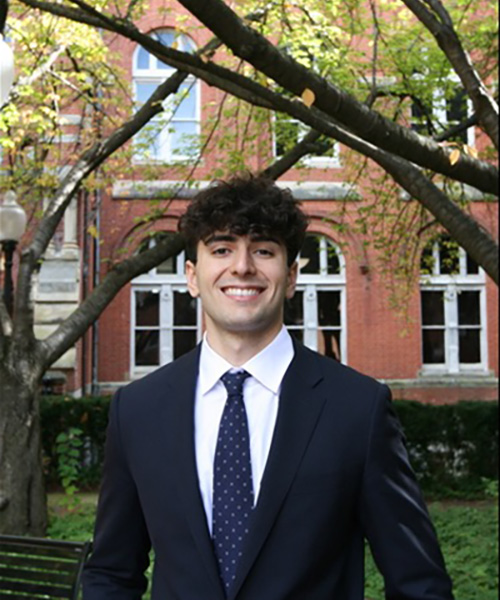
Owen Huang
Tsinghua University professor Da Wei opened our virtual dialogue series with an overview of important upcoming timelines in the U.S.-China relationship, beginning with a May meeting in Beijing between Chinese leader Xi Jinping and an American delegation led by President Donald Trump. Realizing that our trip would take place immediately after this summit reminded me that our student dialogue, however informal, mirrored official conversations with major implications for both countries. As a student of international affairs and Chinese with limited prior exposure to Chinese peers’ perspectives, I entered the U.S.-China Student Dialogue eager to engage with the other side.
Our first virtual group dialogue focused heavily on perception in the U.S.-China relationship, the world’s most important bilateral relationship. While students on both sides were eager to discuss trans-Pacific issues, we understood that the vast majority of American and Chinese citizens have minimal engagement with the other side, and popular perceptions are probably more consequential for the relationship than opinions from those who know the relationship best. Engaging on the topic with my peers at Tsinghua taught me that perceptions on both sides are complicated: skepticism exists, and ties have been strained, but there are important distinctions between attitudes toward governments and those toward ordinary people. We also discussed the media’s role in shaping popular understandings of the other side, which only underscores the value of the opportunity to experience China firsthand with Georgetown. I also hope my Tsinghua peers get the opportunity to experience American life sometime soon.
Over the course of the four virtual dialogues, I was placed in the same group as a couple Tsinghua peers several times, which gave the experience a degree of familiarity and helped me make some genuine personal connections online. A few particular moments of conversation stand out. During one dialogue, after bonding over our various fast-food interests, my group discussed how each other’s countries are portrayed in entertainment. My group in another week’s discussion compared China’s north-south cultural divide to similar divisions in the United States. Finally, I was intrigued by a discussion during the last virtual dialogue about language’s influence on politics. For example, American English has different words for “security” and “safety,” whereas Mandarin Chinese uses “安全” for both concepts. Perhaps language shapes how people think about such issues.
Participating in the virtual dialogue series has led me to respect “Track II” diplomatic channels as a valuable way to diffuse tensions and set the stage for difficult, yet productive conversations. Now, as I prepare to leave for Beijing and meet in person with my peers at Tsinghua, I am even more excited to continue the dialogue. Collaborating on business and trade in the wake of the May 14-15 summit will not be straightforward, but I am ready to embrace the challenge and grateful for the opportunity to do so in China.
Owen Huang (SFS'28) is a student at Georgetown University studying international political economy and Chinese.
Anton Khechoyan | May 14, 2026

Ewa Tryniszewski | May 14, 2026

Julia Revill | May 14, 2026
Justin Angelo | May 14, 2026

Samara Schuman | May 14, 2026

Sarah Lyons | May 14, 2026

Yajat Gupta | May 14, 2026

Zoe Stone | May 14, 2026
Anahita Asudani | May 14, 2026