



An Opportunity to Build Familiarity
Anton Khechoyan | May 14, 2026
Responding To: Georgetown Students Reflect on Spring 2026 Virtual Discussions with Tsinghua University
Justin Angelo
The first part of the U.S.-China Student Dialogue consisted of four virtual dialogues with students from Tsinghua University, conducted over Zoom ahead of an in-person trip to Beijing and Hong Kong. Across these sessions, we discussed geopolitical issues between our two countries, identified areas of both challenge and commonality, and shared what we were each concerned about domestically and personally. This portion of the program was, in some ways, the most difficult, largely because of how little any of us knew one another. I wasn't especially familiar with the other American students, and I had never met any of the Tsinghua students before our first call.
Faculty from both universities set the tone for these discussions. The Tsinghua and Georgetown professors offered what I considered an accurate analysis of the U.S.-China relationship, and one comment in particular stood out: a Tsinghua professor spoke directly about the Chinese nuclear program, stating plainly that he believed it could be more transparent. Beyond these opening remarks, the discussions were left largely to the students to shape. What emerged from that student-led discussion was a relationship neither side treated as adversarial. There was no hesitancy in addressing the U.S.-China relationship directly, and at no point did the conversation feel antagonistic. Both groups seemed to agree that the relationship was fundamentally one of competition, and both affirmed that competition, if managed well, could be beneficial — spurring innovation, particularly in technology and energy.
I did feel restricted in discussing issues I personally care about, including the status of Taiwan as a governing democracy, the Hong Kong democracy protests, and the treatment of Uyghur Muslims in Xinjiang. With the exception of Taiwan, these issues do not define the strategic relationship between our two countries, but they remain among the most sensitive subjects in China. Given how little time I had known the Tsinghua students, raising them did not feel appropriate. My primary concern was putting a fellow student in the position of voicing an opinion at odds with the Chinese government's, particularly on a call I understood could be recorded or monitored.
Comically, I believe the most substantive exchanges came from less strategic territory. The Tsinghua students described a domestic preference for artificial intelligence that eases everyday tasks rather than one oriented toward generative applications, though I noted that this pattern of use is itself what generates the data required to train generative models. Both groups also converged on concerns about an oversaturated job market for degree-holders and the rising cost of energy. On the subject of China's activity abroad, the Chinese students were candid: they did not characterize it as benevolent, conceding instead that it was largely self-serving, pursued where an economic interest existed and not obviously otherwise.
These conversations could have gone deeper, and cultural and political caution on both sides kept them from doing so. Even so, the calls left me with a clear conclusion: the Tsinghua students were just as invested in finding common ground as we were, and neither side carried any real animosity toward the other's people or country.
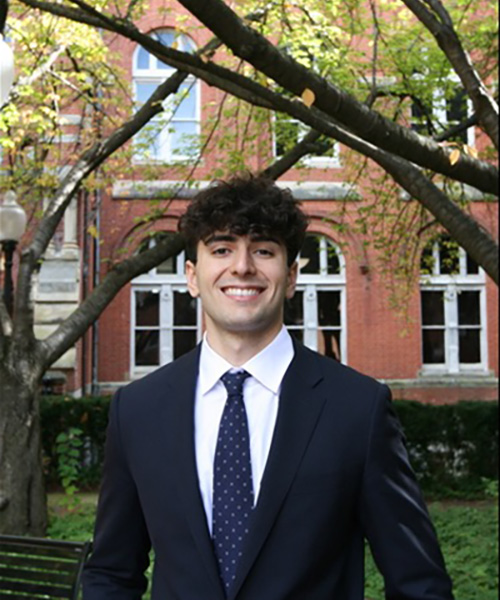
Justin Angelo (SSP'27) is a first-year graduate student in the Security Studies Program at Georgetown University's School of Foreign Service.
Anton Khechoyan | May 14, 2026

Ewa Tryniszewski | May 14, 2026

Julia Revill | May 14, 2026

Owen Huang | May 14, 2026

Samara Schuman | May 14, 2026

Sarah Lyons | May 14, 2026

Yajat Gupta | May 14, 2026

Zoe Stone | May 14, 2026

Anahita Asudani | May 14, 2026